
Journal · Smile Design
Invisalign Before Veneers:
The Enamel You Don't Get Back
You came in wanting veneers and were told to spend six to nine months in aligners first. It sounds like a delay.
It is the difference between a preparation measured in tenths of a millimeter and one measured in whole ones — and enamel does not grow back. In this article, we'll explain why tooth position matters, what changes Invisalign can make, and how it can help us plan a more conservative result that can hold up well over time when veneers are part of the plan.
The original introduction
You have come in wanting veneers. You are told you should spend six to nine months in aligners first. It sounds like a delay, and it sounds like an upsell. It is neither. It is the difference between a conservative veneer case and an aggressive one, and the decision is permanent.
Here is the reasoning, in full, so you can judge it for yourself.
What a veneer actually is
A veneer is a thin shell of porcelain bonded to the front of a tooth. To make room for it, a small amount of enamel is removed — conventionally 0.3 to 0.7mm. That removal is permanent. Enamel does not regenerate.
On a well-positioned tooth, that is a modest, defensible trade. You remove a fraction of a millimeter and you gain a restoration that can serve you for many years.
What changes when the tooth is crooked
Now consider a tooth that is rotated, or sitting forward of its neighbors, or tipped in.
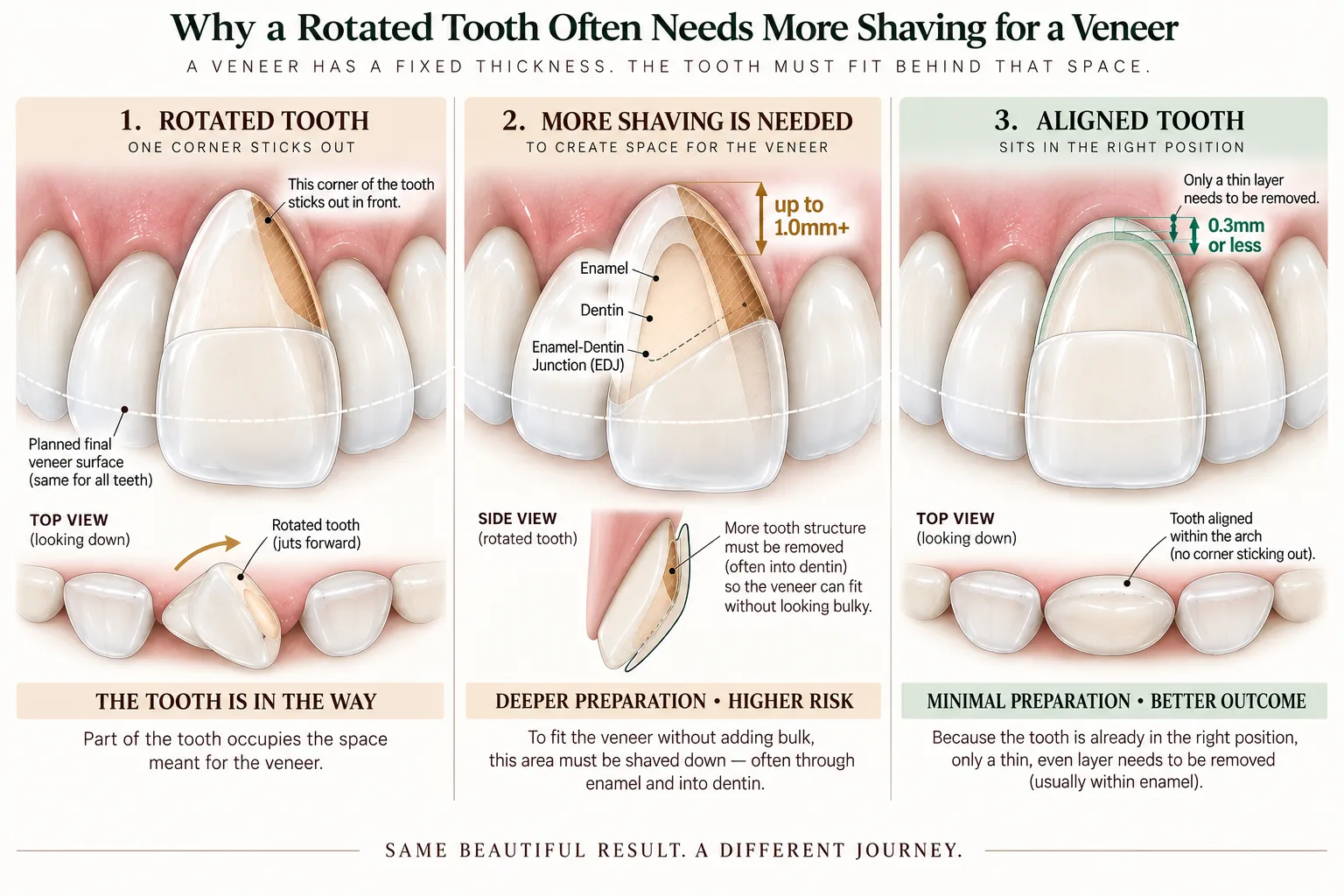
The veneer still has to end up in the correct position — that is the whole point. But the tooth underneath is in the wrong place. So the porcelain has to be thicker on one side and thinner on the other, and where the tooth protrudes, more of it has to come away.
That is not 0.3mm anymore. Depending on how far out of position the tooth sits, it can be double, and on a rotated tooth it can be considerably more. There is only so much enamel available before the preparation reaches dentin.
The principle we work to: more can always be removed. Nothing can be added back. Every case begins with the most conservative preparation the situation allows — and the position of the tooth is what decides how conservative that can be.
Enamel versus dentin
Why reaching dentin matters more than it sounds
This is the part that rarely gets explained, and it may be the most important part of the discussion.
Porcelain adheres to enamel very well. Adhesion to enamel is strong, durable, and well documented over the long term. Adhesion to dentin is a different proposition — generally weaker, more technique-sensitive, and less predictable over time.
So when a preparation goes deep enough to expose dentin, two things happen at once. You have removed more irreplaceable tooth structure, and you have bonded the restoration to a less reliable surface. The veneer may be more likely to need replacing, and there is less tooth left to replace it with. That is how a cosmetic case can turn into a restorative one over the years.
Go deeper, and you lose twice: less tooth, and a less predictable surface to hold the veneer.
The alternative
Move the tooth, then dress it
The alternative is straightforward. Move the tooth into the position the veneer wants it in, and then place the veneer.
When the underlying tooth is already where it should be, the preparation stays minimal. In some cases it stays at zero — a no-prep veneer becomes possible where it would not have been before, because the tooth no longer needs to be reshaped to fake a position it is not in.
The porcelain is then doing what porcelain is good at: color, translucency, surface texture, edge shape. Not structural correction. Not compensating for geometry.
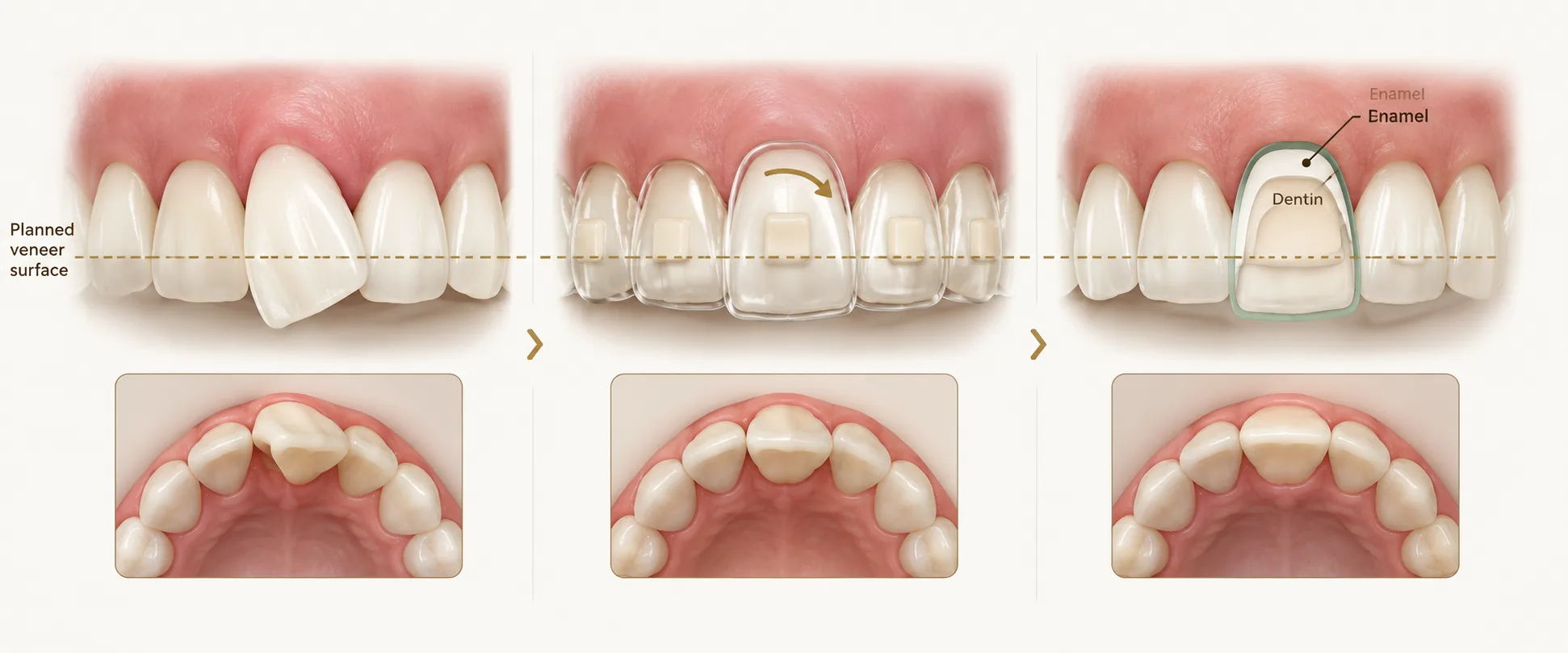
Same result, different route. Both approaches produce a straight-looking smile in the photograph. One of them spent nine months and kept the tooth. The other saved nine months and spent the enamel.
The same logic applies to crowns
Everything above is about veneers because that is the common case, but it holds for crowns too, and more sharply.
A crown removes tooth structure from every surface, not just the front. Placing a full crown on a tooth purely to correct its position — when the tooth itself is sound — is one of the costliest ways to change a tooth's position. Orthodontics moves it and keeps the tooth intact. That is the entire logic behind the way we sequence restorative cases: fix less, preserve more.
It is not only about the front surface
What Invisalign can — and cannot — change
Alignment first also fixes things porcelain cannot fix at all. And some things only the restoration can do.
What alignment can improve
- Gum line position
- If one tooth sits higher or lower than its neighbors, the gum follows it. A veneer can change the shape of a tooth but it cannot move the gum line, and an uneven gum line is often a sign that a cosmetic case was rushed. Moving the tooth moves the tissue with it.
- Proportion
- Crowded teeth are frequently narrower than they should be, because they have worn against each other for years. Straightening opens the arch and lets each tooth be built to its natural proportion, rather than to whatever width is left.
- The bite underneath
- Porcelain placed onto an unstable bite can fail for reasons that have nothing to do with the porcelain. If the front teeth are taking force they were not designed for, new veneers can chip, debond, or wear — and the material will get the blame. This is the same argument our full mouth reconstruction page makes at a larger scale, and it applies just as much to six upper veneers.
What still requires restorative design
- Color
- Moving a tooth does not change its shade. Color is chosen and built into the porcelain.
- Translucency
- How light passes through the edge of a tooth is designed into the restoration.
- Surface texture
- The surface character is shaped so the veneer sits naturally beside the teeth around it.
- Edge shape
- Chipped, worn or short edges are rebuilt in the restoration. Alignment puts the tooth in place; it does not restore what has worn away.
What about mail-order aligners?
Worth addressing directly, because if the argument is "align first," the obvious next thought is to do it cheaply.
Aligners do not express every planned movement at full value. The plastic applies force; biology decides how much of the intended movement actually happens, and it is often less than the digital simulation predicts. That gap is why attachments — the small tooth-colored shapes bonded to teeth during treatment — exist, and why refinement trays are a normal part of a properly run case rather than a sign one went wrong.
A remote aligner plan has no attachments, no mid-course scanning, and nobody looking at your bite. For mild crowding it may be adequate. For a case that is the foundation of a cosmetic result you intend to keep for fifteen years, the tolerance is much tighter — you are not aiming for "straighter," you are aiming for a specific position that a veneer will be built onto. That is what our Invisalign planning is for.
When alignment first is not the answer
How this changes the veneer plan
This is not a universal rule, and it would be dishonest to present it as one.
- The teeth are already well-positioned. If the complaint is shade, small chips, or worn edges, there is nothing to move. Veneers, cosmetic bonding or whitening directly may be the right approach.
- The teeth are already heavily restored. If a tooth already carries a large restoration or a crown, the enamel argument is moot — there is little left to preserve, and moving it may not be worth the time.
- The misalignment is genuinely minor. Fractions of a millimeter can be handled within a conservative preparation. Not everything needs to be moved.
- The patient will not wear the aligners. Twenty to twenty-two hours a day for months is a real commitment. A plan nobody follows is worse than a plan that never accounted for it.
Which category you are in is a clinical judgment, and it is one you should expect to have explained rather than asserted.
What we look at before recommending a sequence
- 1
Tooth position
Where each tooth sits compared with where the finished veneer needs to be. That gap is what sets the preparation depth.
- 2
Enamel
How much enamel each tooth has to work with, and how close a preparation would come to dentin.
- 3
Bite
How the front teeth meet and take force, because porcelain on an unstable bite is more likely to chip or debond.
- 4
Gum architecture
The gum line, tooth by tooth. If it is uneven because a tooth is out of position, moving the tooth is how to level it.
- 5
Final restorative position
Only then the finished position — and whether aligners, a conservative preparation, or both are the way to reach it.
A question worth asking any cosmetic dentist: how much enamel will be removed, and would that number be smaller if the teeth were moved first? If the answer is vague, or if alignment is never raised as an option, that tells you something about how the case is being planned.
The long view
What it costs you
Six to nine months in most cases, sometimes less. There is an added fee for the orthodontic phase. Nobody enjoys hearing that the thing they came in for starts later than expected.
What you get for it is a preparation measured in tenths of a millimeter instead of whole ones, adhesion to enamel rather than dentin, a gum line that is level because the teeth beneath it are, and a restoration that is decorating a sound tooth rather than disguising a misplaced one.
Veneers get replaced eventually — that is expected. What matters is how much tooth is left underneath when that day comes.
Frequently asked questions
Should I get Invisalign before veneers?
In many cases yes. Placing veneers over misaligned teeth often requires removing more enamel to create the appearance of straightness, because the porcelain has to compensate for a tooth that is in the wrong position. Moving the tooth first means the preparation stays minimal, and in some cases a no-prep veneer becomes possible.
How much enamel is removed for veneers?
Conventional veneers require removing roughly 0.3 to 0.7mm of enamel, and that removal is permanent. On a tooth that is rotated or sitting out of position, the preparation has to go deeper on the protruding surface, which can approach or reach dentin.
Why does bonding to dentin matter?
Porcelain adheres to enamel strongly and predictably over the long term. Adhesion to dentin is generally weaker and more technique-sensitive. A preparation deep enough to expose dentin removes more irreplaceable tooth structure and bonds the restoration to a less reliable surface, so the veneer may be more likely to need replacing, with less tooth left to replace it with.
How long does alignment add to a veneer case?
Typically six to nine months, sometimes less, with an added fee for the orthodontic phase. What it buys is a smaller preparation, adhesion to enamel rather than dentin, a level gum line, and more tooth remaining when the veneers eventually need replacing.
Considering veneers? Start with the position of the teeth underneath.
A consultation will tell you whether alignment should come first — and if it should not, we will say so. Come and see us in Venice, or call (941) 477-1977.
Reserve your visit →